

“So, my brother, the answer to my question is “The i problem theory.” I hope you agree that this mathematical equation is enough of an answer to satisfy the question in all of its unknown infinite wisdom—a simple equation to solve simple to complicated life problems. If a person can solve their problems, they may be less likely to want to hurt others.”
– an excerpt from the book
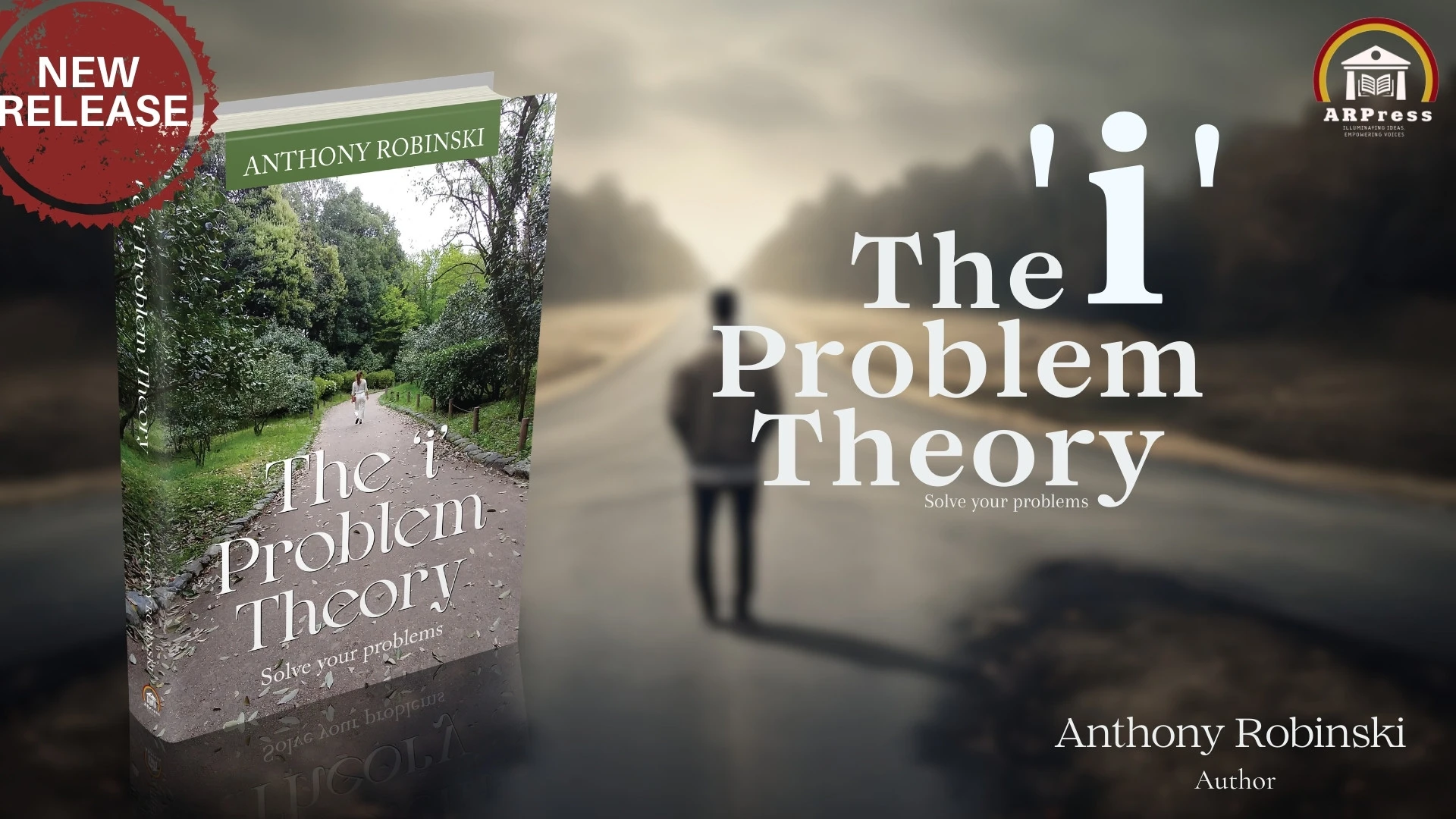
ARPress is honored to publish The ‘i’ Problem Theory: Solve your problems by Anthony Robinski. This book is now available on Amazon, Barnes & Noble, and the ARPress website.
Some days, life feels like standing in the middle of a busy intersection with no traffic lights. Everyone’s moving, everyone’s honking, and somehow you’re expected to know when it’s your turn to go. Problems don’t line up politely. They overlap. They grow teeth. And if you’re not careful, they start to feel bigger than you. But every once in a while, someone comes along and says, “Wait. Slow down. Let’s map this out.” Not with grand speeches. Not with dramatic promises. Just with something simple enough to hold in your hands. An equation, maybe.
That’s the quiet power behind The ‘i’ Problem Theory by Anthony Robinski. It doesn’t try to dazzle you. It doesn’t pretend life is easy. Instead, it starts with a question that feels painfully relevant: why does the world seem so angry? Why do people hurt each other so easily? Robinski’s answer isn’t political or abstract. It’s personal. He suggests that maybe, just maybe, if individuals learned how to solve their own problems, there would be less overflow of pain into the world.
And instead of writing a long philosophical argument, he does something unexpected. He turns the idea into math.
Author Anthony Robinski is a U.S. Navy veteran and author based in Texas. He is the creator of The “i” Problem Theory: Solve Your Problems, a practical framework that helps readers break down the real causes of their challenges rather than chase surface-level fixes. He also writes fiction, including My Super Power Series, a sci-fi saga about ordinary people who discover extraordinary abilities and are forced to grow into the heroes their world needs. Drawing on military experience, hands-on technical work, a lifelong obsession with how people think, change, and overcome adversity, Anthony writes to give readers simple, usable tools for real life, not just inspiration that fades after the last page.
The equation, X + i × (n × O) = Y, becomes the backbone of the book. At first glance, it looks almost too simple. X represents what you’re born into: your family, your starting point, your circumstances. The things you didn’t choose. The capital letter is intentional. It’s fixed. Then there’s “i,” the individual — lowercase, because it’s flexible. It can grow. It can shrink. It’s you, your effort, your mindset. “n” is information (what you learn, research, gather). “O” stands for others (the people you consult, collaborate with, lean on). Y is the result. And L, life, is the messy, unpredictable resistance that makes everything harder than it should be.
It sounds clinical when laid out like that. But in practice, it feels surprisingly human.
Robinski walks through an example about deciding whether to buy a house. It could have been any big decision: a career change, a relationship, starting over, but the house works because it’s both emotional and financial. First, you look at what you have. Then you improve what you can control: your habits, your savings, your knowledge. You research. You ask questions. You talk to experts. You talk to people who’ve lived it. Gradually, what felt overwhelming becomes measurable. You move from “this problem is bigger than me” to “I understand this problem” to “I am bigger than this problem.”
That progression is really the heart of the book. Problems don’t disappear. That part is important. They don’t magically dissolve once you identify them. Instead, you outgrow them. You strengthen your Y (your combined capacity) until the problem no longer dominates you. It’s still there. It just doesn’t own you anymore.
What makes the book interesting is its firmness. Robinski doesn’t coddle the reader. At one point, he even suggests that if you don’t understand the example, you might need to improve your “i” and “n.” It’s a little blunt. Maybe even slightly confrontational. But it fits the philosophy. Growth isn’t passive here. It’s deliberate. Luck isn’t something you wait around for. It’s something you build by increasing your inputs.
The writing itself is direct. No fluff. No long emotional detours. Some readers might wish for deeper storytelling or more vulnerability, but there’s something refreshing about the simplicity. It feels like someone who genuinely believes that clarity can reduce chaos. That structure can reduce fear.
And maybe that’s what makes the message linger. In a world where self-help often leans into hype and big promises, The ‘i’ Problem Theory feels almost stubbornly practical. It keeps circling back to one uncomfortable but empowering truth: you cannot change where you started, but you can change what you do next.
At the end of the day, the book isn’t really about math. It’s about responsibility. About looking at your life and asking, “What can I increase? What can I learn? Who can I ask?” It shifts the focus from blame to leverage. From frustration to strategy.
Life will always throw L into the equation. That’s guaranteed. But Robinski’s argument is that the “i” (the individual) still matters. More than we think. Maybe more than we want to admit.
And there’s something quietly hopeful about that. Not loud hope. Not the kind that shouts from a stage. Just the steady kind that says, if you build yourself strong enough, your problems won’t vanish, but they won’t define you either.
The ‘i’ Problem Theory: Solve your problems by Anthony Robinski is now available for purchase via the ARPress Bookstore.