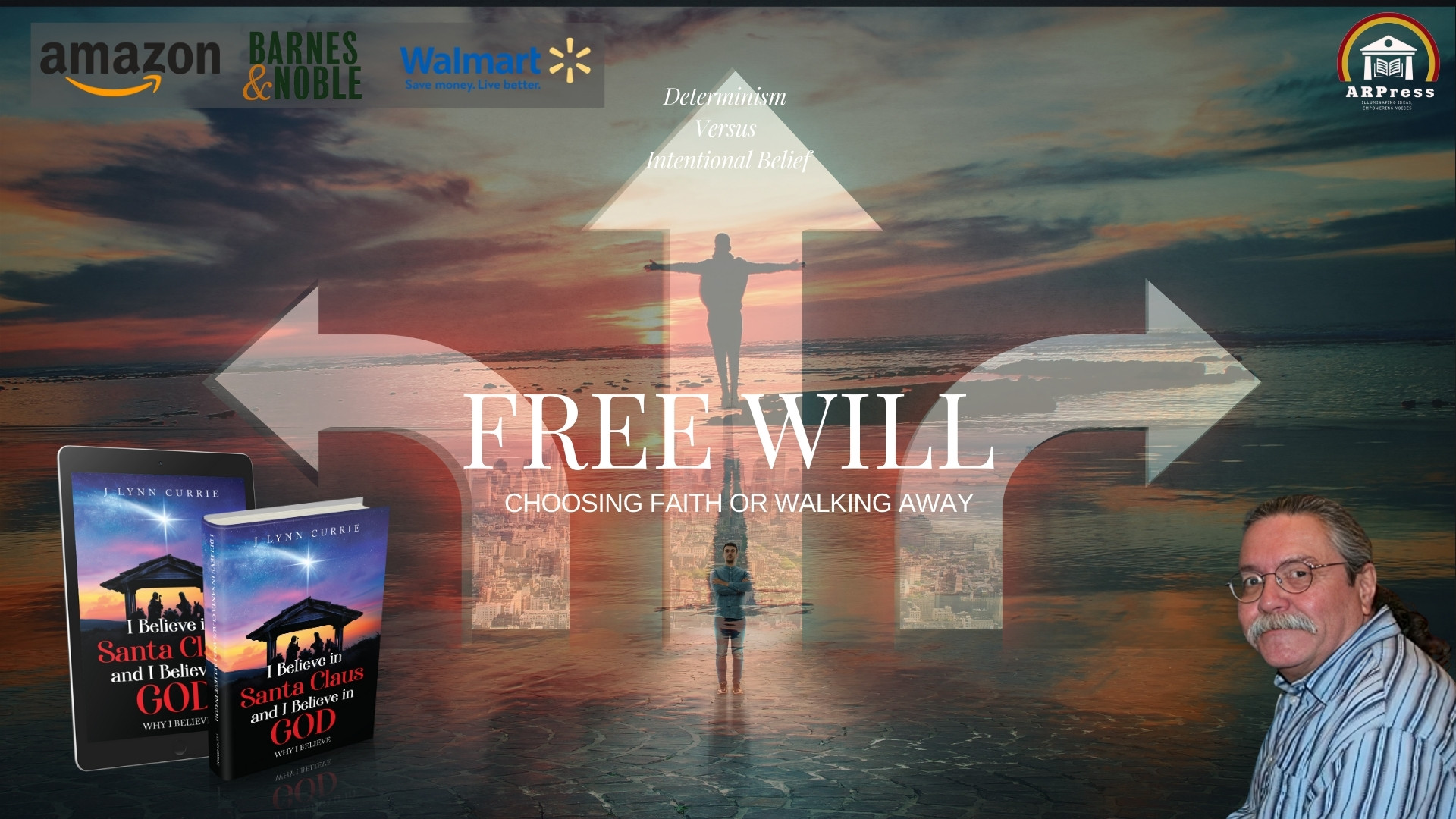
When we talk about free will, we usually picture big life choices: career paths, relationships, maybe even what to eat for dinner. But for J. Lynn Currie, the question cuts deeper. In his book I Believe in Santa Claus and I Believe in God, Currie explores belief itself, where it comes from, how it’s tested, and whether it’s really chosen or shaped by forces beyond us.
Currie frames his journey through an honest lens. As a child, being told he was “too old” to believe in Santa Claus stung, but it also became a metaphor for what many hear later: that they are “too smart” to believe in God. The transition from childhood wonder to adult faith is where the tug-of-war between determinism and intentional belief plays out.
Currie acknowledges the deterministic outlook, that our lives, choices, even beliefs are carved by our biology, environment, and experiences. If that’s the case, then what we believe about God (or don’t) is less a choice and more a consequence. In this view, free will is an illusion.
But he pushes back. If consciousness, language, and moral intuition are real, then so is our ability to pause, reflect, and choose. Belief isn’t just the sum of our neurons firing, it’s also an act of trust, a step taken into something that can’t be proven yet continues to shape reality for billions.
Currie doesn’t claim certainty. In fact, he admits that no one can prove God’s existence or disprove it. What he offers instead is a collection of reasons, experiences, and evidence that, when woven together, make belief in God as rational as disbelief. For him, faith isn’t blind, it’s a reasoned leap, grounded in both science and lived experience.
This is where free will becomes central. Belief in God, unlike belief in gravity, requires an act of volition. You can’t measure God in a lab test, but you can weigh the evidence of design, morality, consciousness, and decide: Do I believe this points to God, or not?
J. Lynn Currie isn’t writing from an ivory tower. His story is marked by faith lost and faith rediscovered. Mentors, friends, and even his own family weave in and out of his journey, offering encouragement, challenges, and sometimes skepticism. His book is not a theologian’s treatise but a personal exploration, one that wrestles with science, philosophy, and theology while staying grounded in lived reality.
Currie’s tone is humble: he calls himself a “poor student of many great minds.” Yet his writing is accessible because he doesn’t pretend to have all the answers. Instead, he invites readers into his thought process, his doubts, and his ultimate conviction that belief in God is a reasonable, even freeing, choice.
So, what about free will? Currie suggests it is precisely in the realm of faith that our freedom matters most. Determinism may explain much about the material world, but when it comes to ultimate questions, why we’re here, what life means, and whether there’s more beyond death, each person stands at a crossroads.
Do we walk away, concluding that belief is a comforting illusion? Or do we choose faith, not as a denial of reason, but as a step toward a reality larger than ourselves?
Currie chose the latter. And in telling his story, he leaves space for readers to wrestle with their own.
Purchase I Believe in Santa Claus and I Believe in God: Why I Believe” by J. Lynn Currie via these links:
- Walmart: https://www.walmart.com/ip/I-Believe-in-Santa-Claus-and-I-Believe-in-God-Why-I-Believe-Hardcover-9798893894424/10717607468?classType=REGULAR&from=/search
- Amazon: https://www.amazon.com/Believe-Santa-Claus-God-Why/dp/B0CYSQBDPW
- ARPress – https://authorreputationpress.com/bookstore/i-believe-in-santa-claus-and-i-believe-in-god-why-i-believe/