
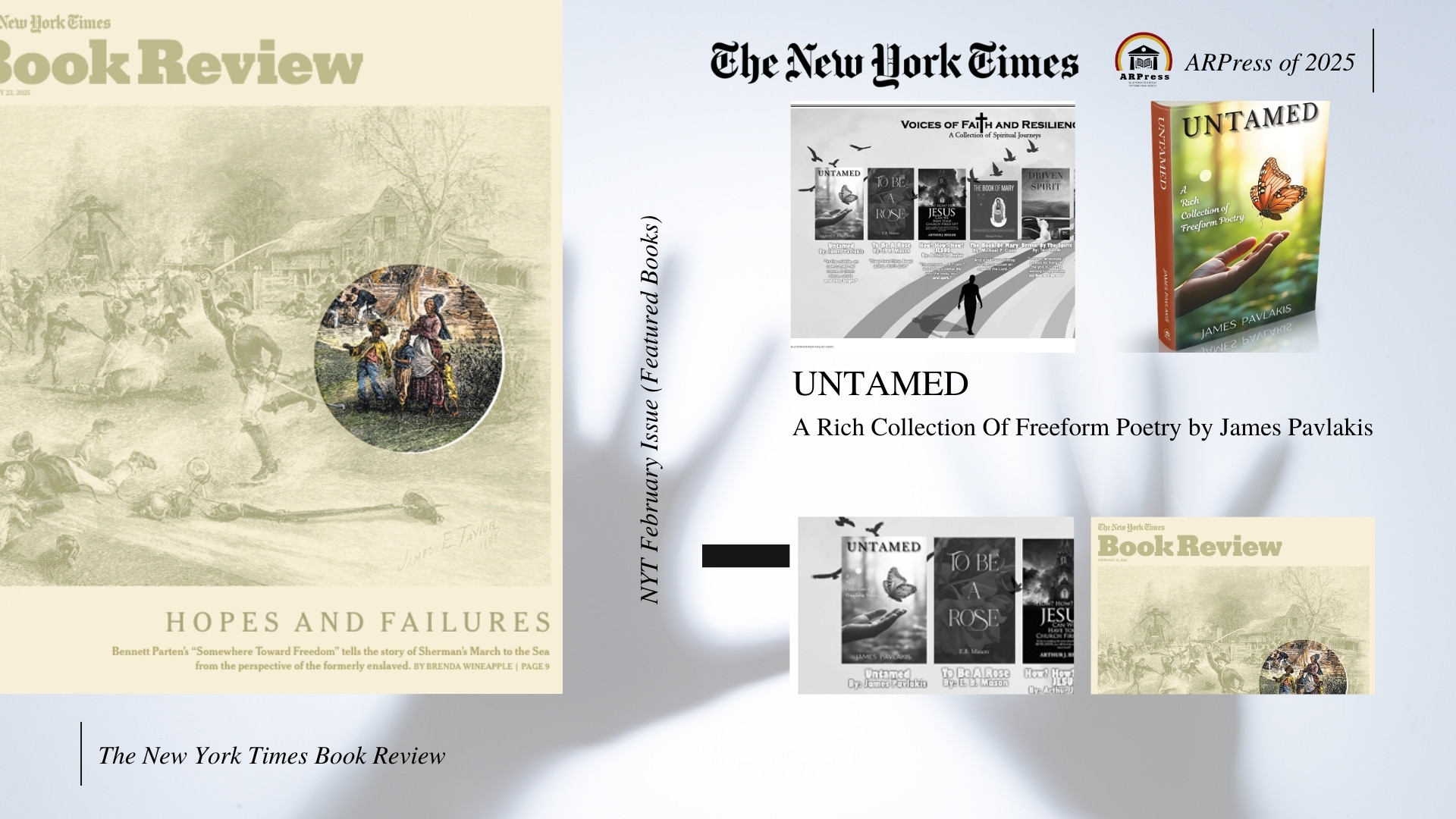
James Pavlakis’ masterpiece, Untamed, was featured in the February 2025 issue of The New York Times Book Review (NYTBR) magazine.
The New York Times Book Review is a weekly magazine supplement included in the Sunday edition of The New York Times, where professional critics review current fiction and nonfiction books. It is considered one of the most influential and widely read book review publications in the world. Essentially, it is a dedicated section within the newspaper that provides in-depth analyses of new books.
NYTBR is a highly regarded weekly magazine dedicated to literary criticism, featuring reviews, essays, and interviews about newly published books across various genres. As part of The New York Times, it plays a significant role in shaping literary trends and influencing readers’ choices. The magazine covers fiction, nonfiction, poetry, and children’s literature, offering in-depth analyses by esteemed critics and authors.
One of its most notable features is The New York Times Best Seller list, which serves as a benchmark for commercial and critical success in the publishing industry. Additionally, its “By the Book” column provides insight into the reading habits of renowned writers. With its long-standing reputation and broad readership, NYTBR continues to be a major force in the literary world, guiding both casual readers and literary enthusiasts in discovering new and noteworthy books.
James Pavlakis, the youngest in a large, art-loving but financially struggling household, grew up on the banks of a river that filled his childhood with fun and nature exploration. Scholarships earned him the first of three college degrees, followed by service in the U.S. Army, where he was stationed in Germany. He took his discharge there and embarked on his first career—writing the never-finished Great American Novel.
His second, more successful career began when he returned to the States, creating innovative Human Resource Development programs, including college tuition assistance for employees in a large corporation. He has lived for extended periods in Germany, Greece, Australia, Portugal, Iran, and Mexico. Now retired, he resides in Arizona.
Untamed: A Rich Collection of Freeform Poetry by James Pavlakis has received acclaim from Jonah Meyer of The US Review of Books. Meyer highlighted:
“Many of the author’s poems effectively express—in a rather dry, matter-of-fact manner—the notion that our daily human bickering over minute matters pales in significance to the larger, ultimate reality: the universe was here long before us, will continue long after we’re gone, and Mother Nature marches onward, as surely as night follows day and spring follows winter. Pavlakis has an accomplished knack for taking a seemingly banal aspect of human life and, through creative wordplay and poetic craft, repositioning it to reveal humanity’s folly. The poet is unafraid to admit collective ignorance, a refreshing and honest approach that adds an extra layer of insight and charm to these poems.”
Pavlakis’ poetry centers on embracing the complexities of human experience. Through varied poetic voices and themes, the collection encourages readers to find strength, authenticity, and clarity in life’s profound moments. It celebrates resilience, emotional expression, and the beauty of individuality, urging an appreciation of diverse perspectives and the courage to confront life’s challenges with honesty and wit.
The subjects explored in this anthology range from ecological poems celebrating nature’s majesty to philosophical musings on time and space, as well as character-driven narrative vignettes that reveal both human determination and heartache. A genuine, often humorous, poetic declaration runs through many of these works, with Pavlakis proclaiming that “small things make good poems.” The collection also delves into darker themes, including death and endings, societal violence, the unknown future of artificial intelligence, and issues of power and class. Other poems examine the nature of language, vivid personal memories, and reflections on modern society as a “cell phone nation.”