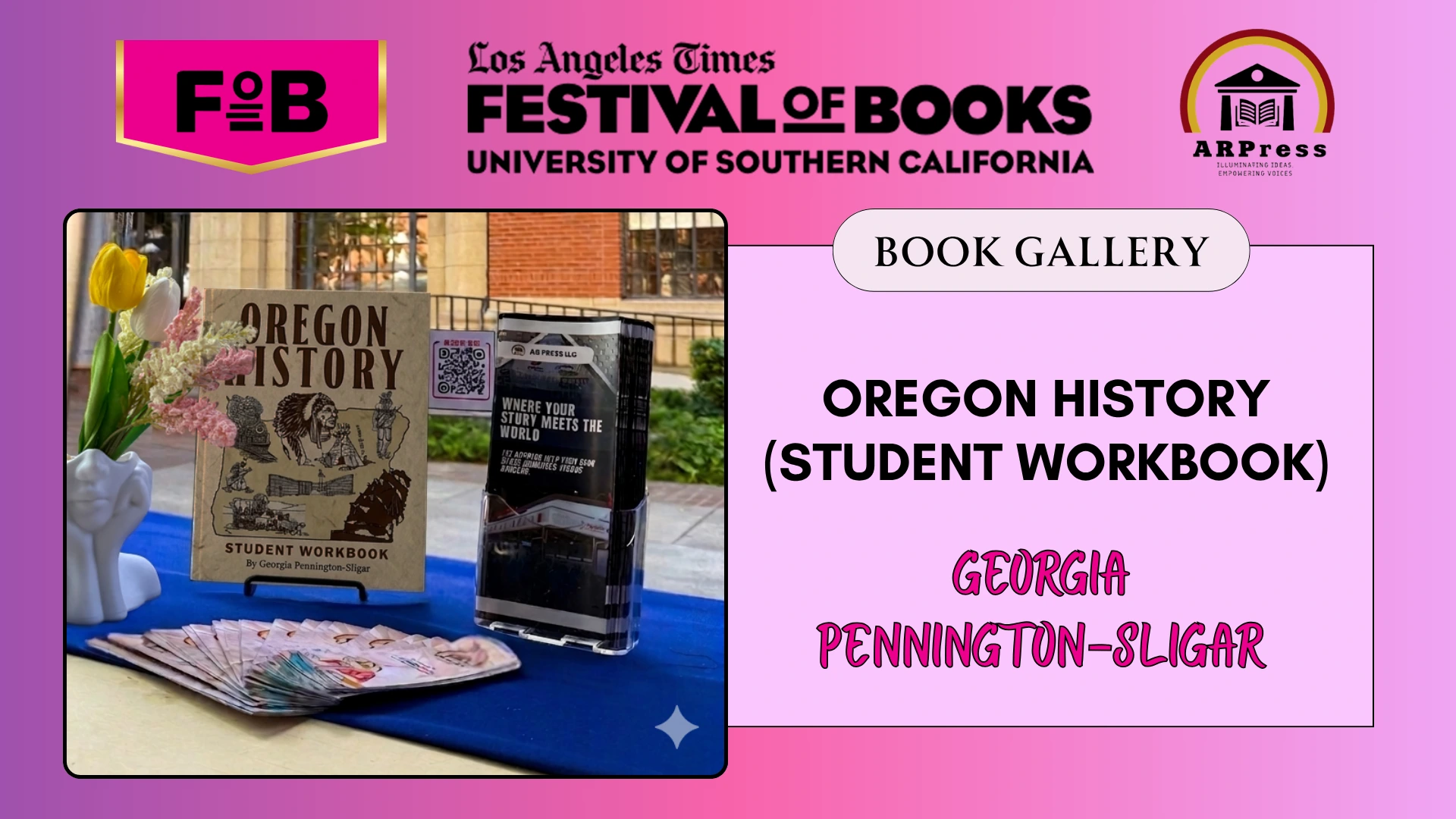
ARPress continues to strengthen its international literary presence through its participation in major global events, and its involvement in the Los Angeles Times Festival of Books (LATFOB) 2026 at the University of Southern California (USC) reflects this ongoing commitment. Taking place on April 18–19, 2026, LATFOB remains one of the most important literary gatherings in the United States, bringing together publishers, authors, and readers in a shared space dedicated to books, ideas, and cultural exchange. ARPress plays a central role in this environment by showcasing its authors, expanding readership opportunities, and connecting its publications with a broad and diverse literary audience.
The festival, organized annually by the Los Angeles Times, serves as a major hub for the publishing industry, where authors and publishers gain visibility, connect with readers, and engage in conversations that shape contemporary literary culture. With hundreds of exhibitors and a wide range of programming, LATFOB creates direct pathways for authors to present new works, reach wider audiences, and participate in discussions that extend beyond the page. For ARPress, this environment supports its mission of amplifying author voices and positioning its catalog within a global literary marketplace.
Across the USC campus, the festival unfolds as a layered cultural experience, with open-air stages, author panels, book signings, and live readings running throughout the weekend. Conversations move fluidly between genres and disciplines, bringing together fiction writers, journalists, poets, and thought leaders in a shared exchange of ideas. Attendees move through exhibitor booths showcasing both major publishing houses and independent presses, discovering new releases and engaging directly with the creative minds behind them.
The festival also creates space for reflection and dialogue through curated programming that addresses contemporary social, cultural, and literary themes. From storytelling sessions to panel discussions on identity, justice, and imagination, the event encourages deeper engagement between writers and readers. This environment fosters not only discovery but also connection, as audiences encounter stories that reflect both personal experience and broader human realities.
Within ARPress’s featured presentation, Oregon History: Student Workbook by Georgia Pennington-Sligar unfolds not as a static compilation of dates and events, but as a guided passage through place, where history becomes something encountered, traced, and gradually understood.
The work moves across the landscape of Oregon not merely as geography, but as memory layered over time. It gathers moments: conflict, discovery, movement, settlement, and arranges them in a way that feels both structured and alive. Designed for young learners, yet carrying a depth shaped by years of research and teaching, it offers more than instruction; it offers orientation within a past that continues to shape the present.
What defines the book is its sense of accessibility without diminishing substance. The narrative is presented in a clear, visual, and engaging format, where learning becomes an active process rather than passive reception. It is built to be navigated, whether independently or within a classroom, allowing each reader to move at their own pace through the unfolding story of a state.
Figures and events are not isolated fragments; they are part of a continuum. From early histories and cultural encounters to moments of expansion and transformation, each section contributes to a larger understanding. The workbook format itself becomes part of the experience, inviting reflection, participation, and a more personal engagement with history.
Underlying the structure is the presence of the author’s long-standing connection to the subject. Georgia Pennington-Sligar brings decades of immersion: travel, research, and teaching, into the work, shaping it with both knowledge and familiarity. What emerges is not distant scholarship, but a lived relationship with the material, translated into a form that can be shared and carried forward.
Beyond the page, the book finds its place within ARPress’s broader literary platform, where titles are brought into visibility through curated bookstore features, educational listings, and participation in wider literary circuits. Within this space, the workbook exists not only as a classroom tool, but as part of a larger effort to position educational texts within global reading communities and book exhibitions.
There is a quiet expansion in that movement. A regional history: specific, grounded, and detailed, extends outward, reaching readers beyond its immediate setting. It becomes both a study of place and an invitation to consider how all histories are learned: through attention, through structure, through the willingness to engage with what came before.
The book lingers in that space between instruction and discovery. It does not overwhelm; it guides. It does not merely inform; it invites participation.
What remains is not just knowledge retained, but a cultivated awareness, a sense that history, when approached with clarity and intention, becomes less about memorization and more about understanding one’s place within a continuing story.
The inclusion of this title within ARPress’s presentation at LATFOB underscores the broader value of the festival itself. The Los Angeles Times Festival of Books functions as more than a book exhibition, it is a vital space where authors and publishers engage directly with readers, where new voices are discovered, and where difficult, thought-provoking stories find visibility and discussion.
For ARPress, participation in LATFOB 2026 reinforces its mission to support authors across diverse genres and backgrounds while expanding the reach of their work to an international audience. The festival offers a unique opportunity to present books in a highly visible, interactive setting where literary discovery and professional collaboration intersect.
Beyond its exhibitor halls and programming stages, LATFOB contributes significantly to cultural life, literary education, and the publishing ecosystem. It supports authors in building readership, helps publishers identify new opportunities, and encourages public engagement with literature in a way that is both accessible and meaningful.
As LATFOB 2026 continues, ARPress remains focused on amplifying voices, strengthening author-reader connections, and ensuring that literary works reach audiences in an environment designed for discovery, dialogue, and lasting literary impact.
Visit the ARPress official social media accounts for more updates.
- https://authorreputationpress.com/
- https://www.instagram.com/authorreputationpress/
- https://www.pinterest.com/arpressllcseo/
- https://twitter.com/ARPressLLC
- https://www.facebook.com/AuthorReputationPressLLC
- https://www.tiktok.com/@authorreputationpress
- https://www.youtube.com/@AUTHORREPUTATIONPRESSLLC