
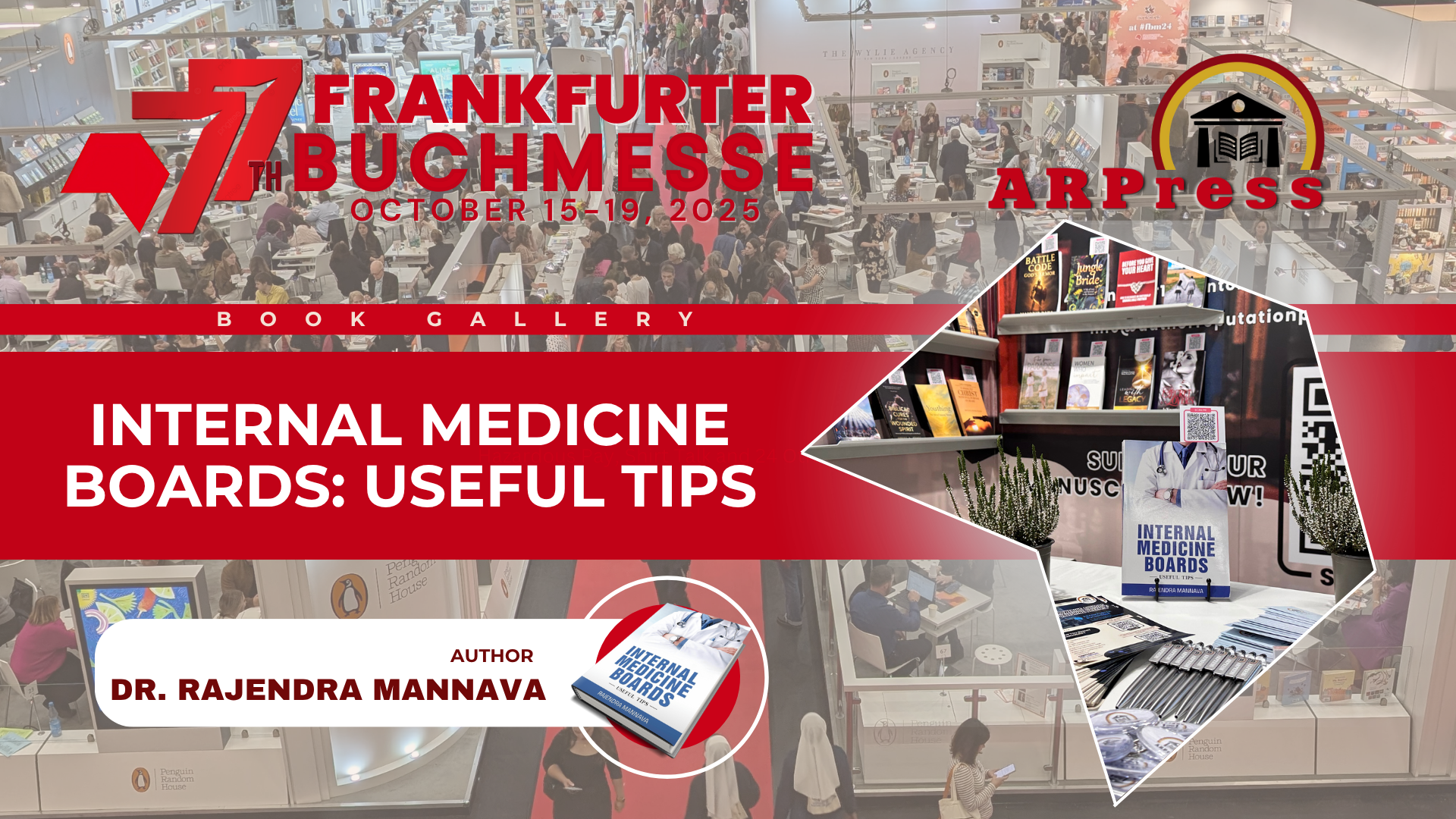
Among the books displayed by ARPress at the Frankfurter Buchmesse in Frankfurt, Germany, from October 15 to 19, 2025, Internal Medicine Boards: Useful Tips by Rajendra Mannava stood out quietly amid the buzz of the world’s largest publishing event. The fair, in its 77th edition, felt like a live pulse of the book-world: five days where ideas, culture, commerce, discovery and connection all collided in one place.
This year, the fair added several new layers of energy. For starters, the Guest of Honour was the Philippines, presenting under the theme “The imagination peoples the air.” That meant a special pavilion, a series of cultural and literary events highlighting Filipino voices and storytelling traditions.
Also, the fair leaned hard into cross-media formats: the newly emphasized “Book-to-Screen Day” on October 17 signaled that publishers and creatives are not just thinking print, but film, TV and streaming. For example, you could stroll from a rights negotiation meeting straight into a panel about turning a novel into a streaming series, then glance over to an audio zone where narrators and audiobook tech were on show.
The public programme (open to all from Friday onward) featured a dizzying range of stages: manga, comics, cosplay and games got serious space this year; there was a “Centre Stage” in Hall 4.1 for cultural and political talks (featuring big names like a Nobel Peace Prize laureate and ex-NATO Secretary General) and a “Reading Zone of Independent Publishers” where up-and-coming voices were amplified. Even the logistics showed how the fair is living up to its global claims: over 4,000 exhibitors from across the world, and the event is framed as “the defining fair for the print and digital content business.”
The opening hours show the rhythm: trade visitors got access from 15-18 October, while the general public could join in on Friday, Saturday, and Sunday. What this means in practical terms: imagine showing up early in the week for rights talks or author meet-ups; imagine a Saturday afternoon where the booths flood with families, manga fans in cosplay, readers browsing new titles, authors signing, coffee in hand. Meanwhile, behind the scenes, deals are being made, translation contracts drawn up, creators from around the world comparing notes. The venue itself, Messe Frankfurt, becomes a micro-city of publishing, buzzing with voices, booths, panels, and unexpected side-conversations in hallways.
For a book like Internal Medicine Boards: Useful Tips by Rajendra Mannava, this is fertile ground. In a setting where major genre titles can dominate the spotlights, the special, quieter books still find their nook, but now with the benefit of tremendous visibility. The broader themes of fair, cross-media adaptation, international rights, younger reader engagement, and creative-tech intersections mean that even a book whose focus is more contemplative or niche can ride the wave of attention simply by showing up in the right context.
Internal Medicine Boards: Useful Tips is a focused and accessible guide designed to help physicians and medical trainees prepare for the American Board of Internal Medicine (ABIM) exams. The book offers succinct summaries, practical insights, and visual aids to assist in reviewing key internal medicine topics. The scope includes general internal medicine, subspecialties across cardiology, pulmonology, nephrology, endocrinology, gastroenterology, rheumatology, dermatology, neurology, and more.
The review also applauded the full-color illustrations and diagrams—which include everything from detailed drawings of the tongue to satirical commentary—calling them “excellent” and helpful for visual learning. Mannava organizes the book into three broad sections: General (infectious disease, oncology, hematology, allergy/immunology), Regional/Subspecialty (heart, lungs, kidneys, hormones, GI, neurology, rheumatology, skin), and Other Areas (general medicine, geriatrics, psychiatry, reproductive health).
Each entry presents a clinical topic by highlighting its key features: presentation, differential diagnosis, comorbidities, diagnostic tests, and treatment strategies. The aim is to deliver “concentrated, critical information” that candidates can use during their study review.
The visual component enhances comprehension. The diagrams and illustrations serve as cognitive anchors—helping readers remember complex anatomy, physiology, and pathology. The inclusion of satirical or creative designs suggests the author understands the value of keeping learners engaged. In short, the book is more than a fact compendium; it’s a review tool crafted to give clinicians an edge on exam day.
Internal Medicine Boards: Useful Tips is a timely and practical tool for physicians and trainees heading into internal medicine board exams. Rajendra Mannava delivers not just facts, but strategically designed content that recognizes how professionals study under pressure. With clear explanations, smart visuals, and clinical grounding, this book is well poised to become a go-to resource for internal medicine review.
This book fills a niche for clinicians who want a compact, high-yield resource that bridges clinical insight and exam preparation.
This year’s Frankfurter Buchmesse felt alive with possibility. The cultural dimension (Philippines guest of honour), the expanded public access, the varied programming (from comics to film-industry panels), the global-rights stage, all of that created a backdrop where a book doesn’t just have to be good, it has to connect. And walking among the stalls, one could almost sense the collision of story and technology, tradition and innovation, local voices and global echo.
So, when someone notices Internal Medicine Boards: Useful Tips by Rajendra Mannava in ARPress’s display, maybe on a table near the broader non-fiction section, maybe in a quiet corner of a genre bay, they’re not just seeing a book. They’re seeing it in a moment: a moment of publishing’s future meeting its roots; a story offered amid thousands of others, inviting a reader to pause, to pick it up, to ask “what might this one say to me?” And perhaps that is why books like this matter even more in a fair like this, because among the big lights and big deals, there’s still space for the voice that whispers rather than shouts, for the reader who wanders, for the author who offers something earnest.
Visit the ARPress official social media accounts for more updates.
- https://authorreputationpress.com/
- https://www.facebook.com/AuthorReputationPressLLC
- https://www.instagram.com/authorreputationpress/
- https://www.pinterest.com/arpressllcseo/
- https://x.com/ARPressLLC
- https://www.tiktok.com/@arpressllc
- https://www.youtube.com/@AUTHORREPUTATIONPRESSLLC