
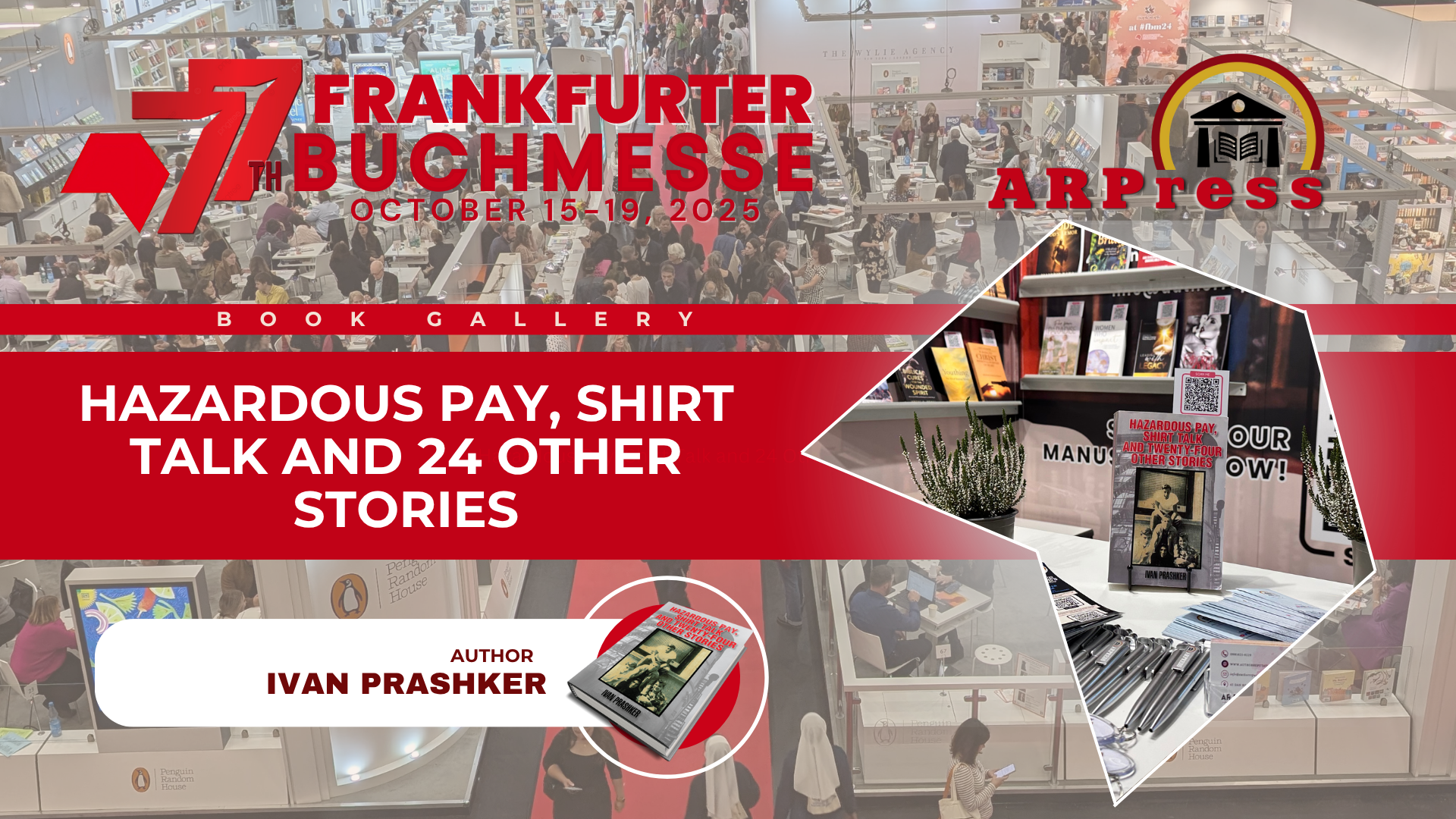
Among the books displayed by ARPress at the Frankfurter Buchmesse in Frankfurt, Germany, from October 15 to 19, 2025, Hazardous Pay, Shirt Talk and Twenty-Four Other Stories by Ivan Prashker stood out quietly amid the buzz of the world’s largest publishing event. The fair, in its 77th edition, felt like a live pulse of the book-world: five days where ideas, culture, commerce, discovery and connection all collided in one place.
This year, the fair added several new layers of energy. For starters, the Guest of Honour was the Philippines, presenting under the theme “The imagination peoples the air.” That meant a special pavilion, a series of cultural and literary events highlighting Filipino voices and storytelling traditions.
Also, the fair leaned hard into cross-media formats: the newly emphasized “Book-to-Screen Day” on October 17 signalled that publishers and creatives are not just thinking print, but film, TV and streaming. For example, you could stroll from a rights negotiation meeting straight into a panel about turning a novel into a streaming series, then glance over to an audio zone where narrators and audiobook tech were on show.
The public programme (open to all from Friday onward) featured a dizzying range of stages: manga, comics, cosplay and games got serious space this year; there was a “Centre Stage” in Hall 4.1 for cultural and political talks (featuring big names like a Nobel Peace Prize laureate and ex-NATO Secretary General) and a “Reading Zone of Independent Publishers” where up-and-coming voices were amplified. Even the logistics showed how the fair is living up to its global claims: over 4,000 exhibitors from across the world, and the event framed as “the defining fair for the print and digital content business.”
The opening hours show the rhythm: trade visitors got access from 15-18 October, while the general public could join in on Friday, Saturday and Sunday. What this means in practical terms: imagine showing up early in the week for rights talks or author meet-ups; imagine a Saturday afternoon where the booths flood with families, manga fans in cosplay, readers browsing new titles, authors signing, coffee in hand. Meanwhile behind the scenes, deals are being made, translation contracts drawn up, creators from around the world comparing notes. The venue itself, Messe Frankfurt, becomes a micro-city of publishing, buzzing with voices, booths, panels, unexpected side-conversations in hallways.
For a book like Hazardous Pay, Shirt Talk and Twenty-Four Other Stories by Ivan Prashker, this is fertile ground. In a setting where major genre titles can dominate the spotlights, the special, quieter books still find their nook, but now with the benefit of tremendous visibility. The broader themes of fair, cross-media adaptation, international rights, younger reader engagement, creative-tech intersections, mean that even a book whose focus is more contemplative, or niche can ride the wave of attention simply by showing up in the right context.
Life, in all its unpredictability, is a story worth telling—sometimes funny, sometimes absurd, and often deeply moving. In Hazardous Pay, Shirt Talk and Twenty-Four Other Stories by Ivan Prashker, readers are treated to a masterful collection that captures these contradictions with wit, warmth, and an unflinching eye for truth. Each story stands on its own, yet together, they form a compelling mosaic of modern human experience, revealing how laughter and reflection often walk hand in hand.
Prashker’s collection is rich with characters who linger in the mind—ordinary people navigating the unpredictability of life with grace, humor, and the occasional stumble. His protagonists include those caught in awkward conversations, impossible situations, and moments of self-reckoning that feel universal. From soldiers facing moral dilemmas to everyday dreamers searching for meaning, each story holds up a mirror to our shared humanity.
What makes this collection remarkable is the author’s ability to balance poignancy with levity. Even in stories that tackle loss or frustration, there’s always a spark of humor or hope—a gentle reminder that the human spirit endures, even under “hazardous pay.” The rhythm of Prashker’s prose, his ear for dialogue, and his keen observational style transform these short tales into vivid emotional experiences.
Ivan Prashker writes not only with skill but with empathy. His voice is that of an observer who has lived, laughed, and learned from the world’s contradictions. In every line, readers sense a storyteller who understands the delicate balance between irony and sincerity. His humor is never cruel, his insights never forced. Instead, he invites readers to explore the ordinary moments that make life extraordinary.
Hazardous Pay, Shirt Talk and Twenty-Four Other Stories isn’t just a book—it’s a journey through the complexities of the human condition. Prashker captures fleeting moments that many writers overlook: a conversation at the wrong time, an act of quiet courage, a burst of laughter in the middle of grief. These are stories that reveal how life, no matter how chaotic, always finds its way back to meaning.
For anyone who believes that great literature can be both entertaining and profound, Hazardous Pay, Shirt Talk and Twenty-Four Other Stories is a must-read—a reminder that even amid life’s hazards, laughter and heart are never far behind.
This year’s Frankfurter Buchmesse felt alive with possibility. The cultural dimension (Philippines guest of honour), the expanded public access, the varied programming (from comics to film-industry panels), the global-rights stage, all of that created a backdrop where a book doesn’t just have to be good, it has to connect. And walking among the stalls, one could almost sense the collision of story and technology, tradition and innovation, local voices and global echo.
So, when someone notices Hazardous Pay, Shirt Talk and Twenty-Four Other Stories by Ivan Prashker in ARPress’s display, maybe on a table near the broader non-fiction section, maybe in a quiet corner of a genre bay, they’re not just seeing a book. They’re seeing it in a moment: a moment of publishing’s future meeting its roots; a story offered amid thousands of others, inviting a reader to pause, to pick it up, to ask “what might this one say to me?” And perhaps that is why books like this matter even more in a fair like this, because among the big lights and big deals, there’s still space for the voice that whispers rather than shouts, for the reader who wanders, for the author who offers something earnest.
Visit the ARPress official social media accounts for more updates.
- https://authorreputationpress.com/
- https://www.facebook.com/AuthorReputationPressLLC
- https://www.instagram.com/authorreputationpress/
- https://www.pinterest.com/arpressllcseo/
- https://x.com/ARPressLLC
- https://www.tiktok.com/@arpressllc
- https://www.youtube.com/@AUTHORREPUTATIONPRESSLLC