
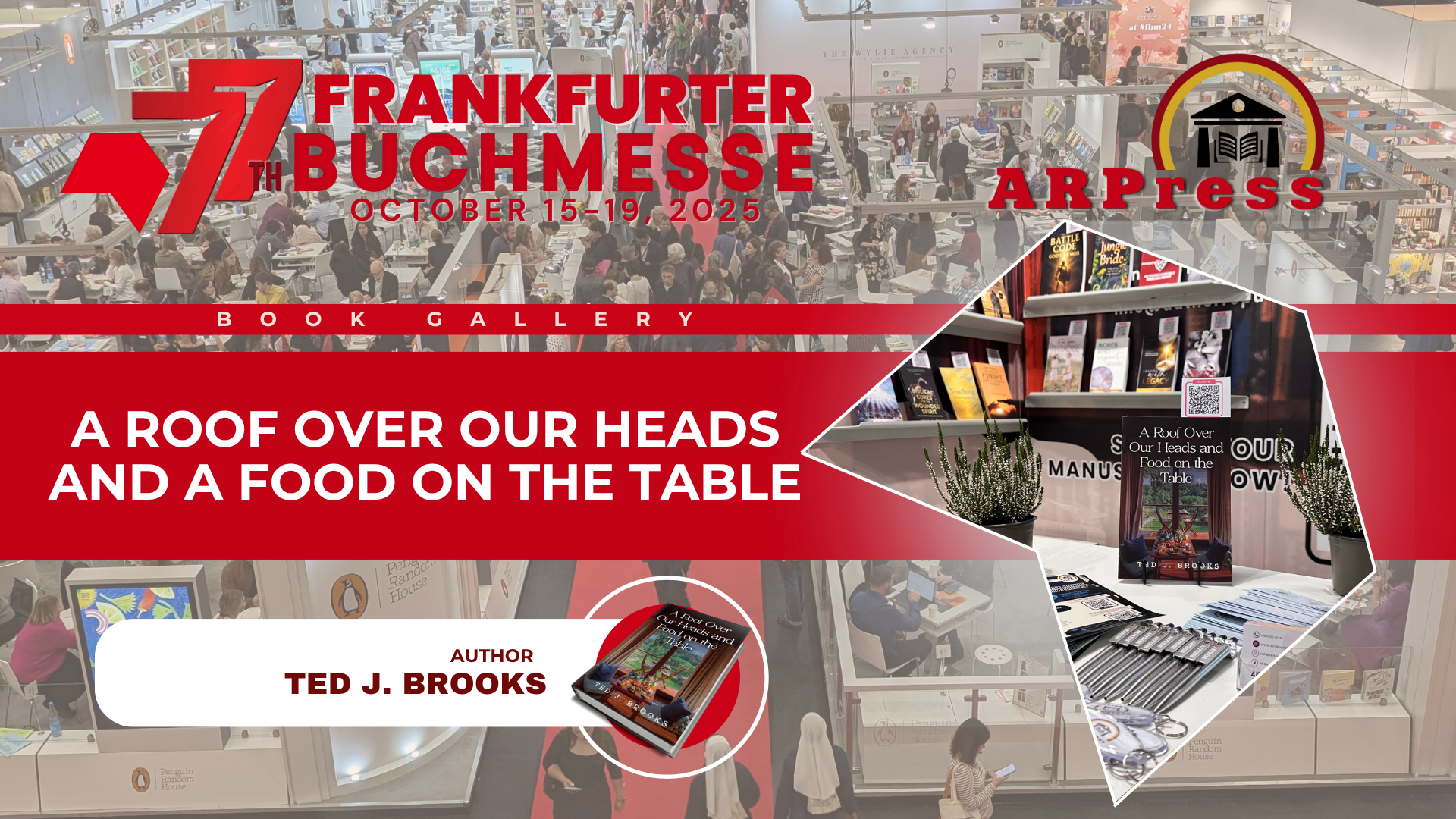
Among the books displayed by ARPress at the Frankfurter Buchmesse in Frankfurt, Germany, from October 15 to 19, 2025, A Roof Over Our Heads and Food on the Table by Ted J. Brooks stood out quietly amid the buzz of the world’s largest publishing event. The fair, in its 77th edition, felt like a live pulse of the book-world: five days where ideas, culture, commerce, discovery and connection all collided in one place.
This year, the fair added several new layers of energy. For starters, the Guest of Honour was the Philippines, presenting under the theme “The imagination peoples the air.” That meant a special pavilion, a series of cultural and literary events highlighting Filipino voices and storytelling traditions.
Also, the fair leaned hard into cross-media formats: the newly emphasized “Book-to-Screen Day” on October 17 signalled that publishers and creatives are not just thinking print, but film, TV and streaming. For example, you could stroll from a rights negotiation meeting straight into a panel about turning a novel into a streaming series, then glance over to an audio zone where narrators and audiobook tech were on show.
The public programme (open to all from Friday onward) featured a dizzying range of stages: manga, comics, cosplay and games got serious space this year; there was a “Centre Stage” in Hall 4.1 for cultural and political talks (featuring big names like a Nobel Peace Prize laureate and ex-NATO Secretary General) and a “Reading Zone of Independent Publishers” where up-and-coming voices were amplified. Even the logistics showed how the fair is living up to its global claims: over 4,000 exhibitors from across the world, and the event framed as “the defining fair for the print and digital content business.”
The opening hours show the rhythm: trade visitors got access from 15-18 October, while the general public could join in on Friday, Saturday and Sunday. What this means in practical terms: imagine showing up early in the week for rights talks or author meet-ups; imagine a Saturday afternoon where the booths flood with families, manga fans in cosplay, readers browsing new titles, authors signing, coffee in hand. Meanwhile behind the scenes, deals are being made, translation contracts drawn up, creators from around the world comparing notes. The venue itself, Messe Frankfurt, becomes a micro-city of publishing, buzzing with voices, booths, panels, unexpected side-conversations in hallways.
For a book like A Roof Over Our Heads and Food on the Table by Ted J. Brooks, this is fertile ground. In a setting where major genre titles can dominate the spotlights, the special, quieter books still find their nook, but now with the benefit of tremendous visibility. The broader themes of fair, cross-media adaptation, international rights, younger reader engagement, creative-tech intersections, mean that even a book whose focus is more contemplative, or niche can ride the wave of attention simply by showing up in the right context.
A Roof Over Our Heads and Food on the Table is a heartfelt coming-of-age novel that explores the tensions of identity, faith, ambition and familial expectation. The story centers on Pat Kavanaugh, a young man from Connecticut yearning to be a writer, yet pulled by his father’s practical expectations into more stable career paths. As Pat navigates college, faith, work and relationships, Brooks invites the reader to reflect on what it means to grow up, to belong, and to stand for more than just survival.
Pat Kavanaugh enters Nutmeg State University with dreams of majoring in English and becoming a writer. But his father, worried about his future, pressures him toward accounting—a safer, more traditional path. While in college Pat meets his roommate Sean Donnelly; both Irish-American, they forge a close friendship that becomes a spiritual anchor for Pat. Through jobs such as working as a cashier at Delacroix’s Grocery Store, apartment living, Sunday Mass attendance at All-Saints Church, and involvement in a questionable business investment, Pat wrestles with the conflict between ambition, faith and compromise. The novel paints Pat’s challenges realistically: the gap between dreams and practicalities, the allure of commercialism vs. spiritual integrity, and the search for meaning beyond a paycheck.
This novel stands out for several reasons. It doesn’t shy away from portraying the “ordinary” work-world realities—cashiering, job searches, career frustration—yet it imbues them with deeper meaning. The character of Pat is relatable: he’s ambitious but unsure, faithful but tempted, striving for writing yet mired in retail. The setting’s authenticity—college, grocery store-job, apartment living—roots the bigger themes of identity and faith in everyday life, making the story accessible. Readers seeking reflections on young adulthood, the interplay of career and calling, or questions of faith in a commercial age will find this book meaningful.
A Roof Over Our Heads and Food on the Table offers a sincere, thoughtful exploration of growing up under conflicting pressures: societal expectation and personal aspiration; faith and commercialism; family obligation and individual calling. Brooks crafts a story that is neither grandiose nor sensational—it is the story of many, though not always told. His realistic lens and grounded characters make the book both representative and refreshing.
For readers looking to reflect on where they are heading, what they value and how they choose to live, Pat’s story provides encouragement, challenge and resonance.
This year’s Frankfurter Buchmesse felt alive with possibility. The cultural dimension (Philippines guest of honour), the expanded public access, the varied programming (from comics to film-industry panels), the global-rights stage, all of that created a backdrop where a book doesn’t just have to be good, it has to connect. And walking among the stalls, one could almost sense the collision of story and technology, tradition and innovation, local voices and global echo.
So, when someone notices A Roof Over Our Heads and Food on the Table by Ted J. Brooks in ARPress’s display, maybe on a table near the broader non-fiction section, maybe in a quiet corner of a genre bay, they’re not just seeing a book. They’re seeing it in a moment: a moment of publishing’s future meeting its roots; a story offered amid thousands of others, inviting a reader to pause, to pick it up, to ask “what might this one say to me?” And perhaps that is why books like this matter even more in a fair like this, because among the big lights and big deals, there’s still space for the voice that whispers rather than shouts, for the reader who wanders, for the author who offers something earnest.
Visit the ARPress official social media accounts for more updates.
- https://authorreputationpress.com/
- https://www.facebook.com/AuthorReputationPressLLC
- https://www.instagram.com/authorreputationpress/
- https://www.pinterest.com/arpressllcseo/
- https://x.com/ARPressLLC
- https://www.tiktok.com/@arpressllc
- https://www.youtube.com/@AUTHORREPUTATIONPRESSLLC