
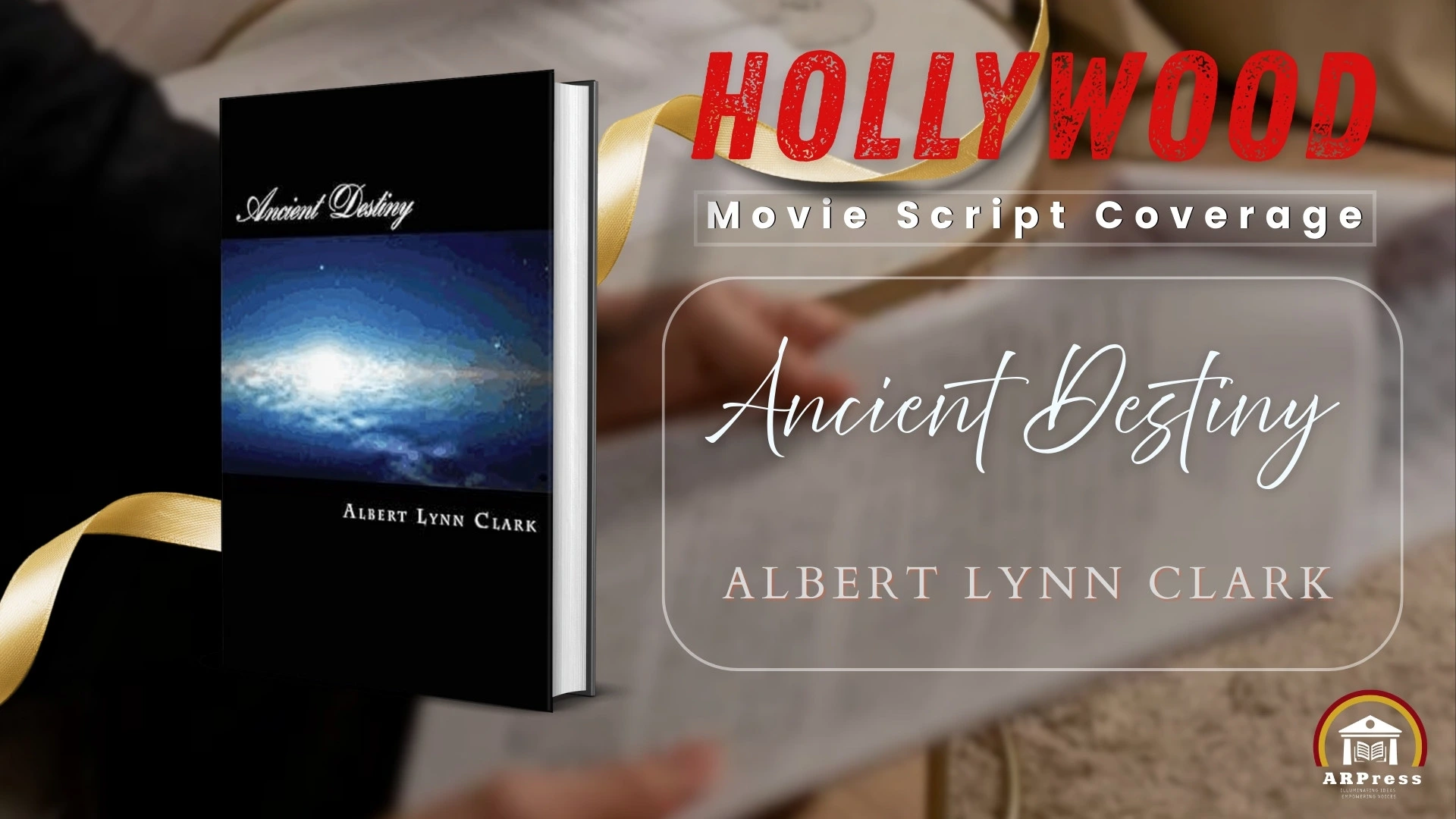

ARPress’ Movie Script Coverage Service is designed to create a clear, professional outline of an author’s book, specifically tailored for adaptation consideration, that will be archived in a database accessible to major studios seeking material for film and television development. This service works as both an evaluative lens and a translation bridge, shaping long-form literary material into a format that aligns with how stories are assessed, developed, and ultimately visualized on screen.
Ancient Destiny by Albert Lynn Clark introduces a high-concept science fiction narrative built around urgency, scale, and sudden responsibility. The story asks a familiar but effective question: what happens when an entirely unprepared person is handed the fate of the world? Rather than easing into heroism, the book throws its protagonist into the deep end almost immediately, blending cosmic technology with very human flaws. The result is a story that moves fast, thinks big, and isn’t afraid to lean into uncomfortable moral territory.
The path from book to screen adaptation requires structured intermediary steps that clarify how imaginative or idea-driven material can translate into compelling visual storytelling. One of the most important of these steps is the move from script coverage to a treatment. Coverage evaluates narrative strength, themes, and cinematic potential, while the treatment reshapes that material into a cohesive, screen-ready blueprint. This transition marks the shift from analysis to creative interpretation, where abstract concepts become characters, momentum, and on-screen consequence.
A screenplay ultimately becomes the shared language between producers, directors, actors, and the creative team, defining tone, pacing, and audience engagement. The goal of the Movie Script Coverage Service is to establish that foundation early by identifying the narrative spine, core conflicts, and adaptation potential before formal screenplay development begins.
A defining focus of Ancient Destiny is the collision between ordinary life and extraordinary power. Craig Decker begins as a laid-back college student with no particular ambition to save humanity, which makes his sudden selection by an ancient, sentient spaceship both ironic and dramatically effective. The story leans into this contrast, placing Craig’s casual morality and impulsive decision-making against the absolute stakes of planetary extinction.
Time pressure functions as a central engine of the narrative. Initially framed as a long-term threat, the asteroid danger abruptly accelerates into a two-year deadline, instantly transforming the story from speculative science fiction into a race against the clock. This shift reframes every decision, pushing the narrative into a more intense, high-stakes zone that naturally lends itself to cinematic escalation.
Another significant theme is power without preparation. Craig’s access to advanced alien technology allows him to solve global problems almost overnight: curing diseases, dismantling criminal networks, and forcing world leaders into compliance. At the same time, the story doesn’t fully let him off the hook for how that power is used. His missteps, ethical blind spots, and moments of selfish curiosity create friction that keeps the protagonist imperfect and, at times, unsettling. This tension is one of the book’s more interesting qualities from an adaptation standpoint.
Ancient Destiny follows a progressive structure that builds momentum through revelation rather than traditional character arcs. The narrative moves from discovery, to experimentation, to global intervention, and finally into existential urgency once the true timeline is revealed. Though the book remains unfinished, its internal progression clearly points toward large-scale construction, accelerated training, and an inevitable launch toward the unknown.
Though the story is plot-driven, characterization emerges through contrast. Craig Decker is positioned as raw potential (brilliant but undisciplined) while the Ship itself operates as a rigid, logic-driven presence bound by ancient rules. This dynamic creates an ongoing philosophical conflict between human intuition and machine necessity, a tension that plays well on screen.
Dawn Weathers serves as the narrative’s emotional and intellectual anchor. Her expertise in astrophysics fills a critical gap in the Ship’s capabilities, and her skepticism grounds the story during its more extreme turns. Her relationship with Craig evolves quickly, but it carries narrative weight by balancing his impulsiveness with competence and restraint. Together, they form a functional dual-lead dynamic that strengthens the story’s credibility.
The narrative voice of Ancient Destiny is direct and unfiltered, often prioritizing momentum over polish. It leans into big ideas, quick turns, and bold decisions, trusting the scope of the premise to carry the reader forward. While some elements would require refinement for adaptation, particularly tonal consistency and ethical framing, the story’s ambition is clear.
Conceptually, the book rests on the idea that survival demands uncomfortable choices. Ancient technology, rigid survival logic, and biological pragmatism clash with modern values, forcing characters to navigate morally gray territory under impossible deadlines. These pressures create a strong foundation for dramatic conflict and thematic exploration.
From an adaptation standpoint, Ancient Destiny lends itself most naturally to a large-scale science fiction feature or limited series. Its visual potential (instant fabrication, teleportation, spaceflight, and global intervention) offers frequent opportunities for spectacle, while the ticking clock and incomplete source material allow room for a definitive, cinematic conclusion to be crafted.
Ancient Destiny presents a bold, fast-moving science fiction framework driven by urgency, power, and consequence. Its strength lies in its willingness to push a flawed protagonist into impossible circumstances and let the tension play out on a global stage. With thoughtful adaptation and narrative refinement, the story offers strong potential as a high-concept, visually driven sci-fi property built around a race to save humanity before time simply runs out.