
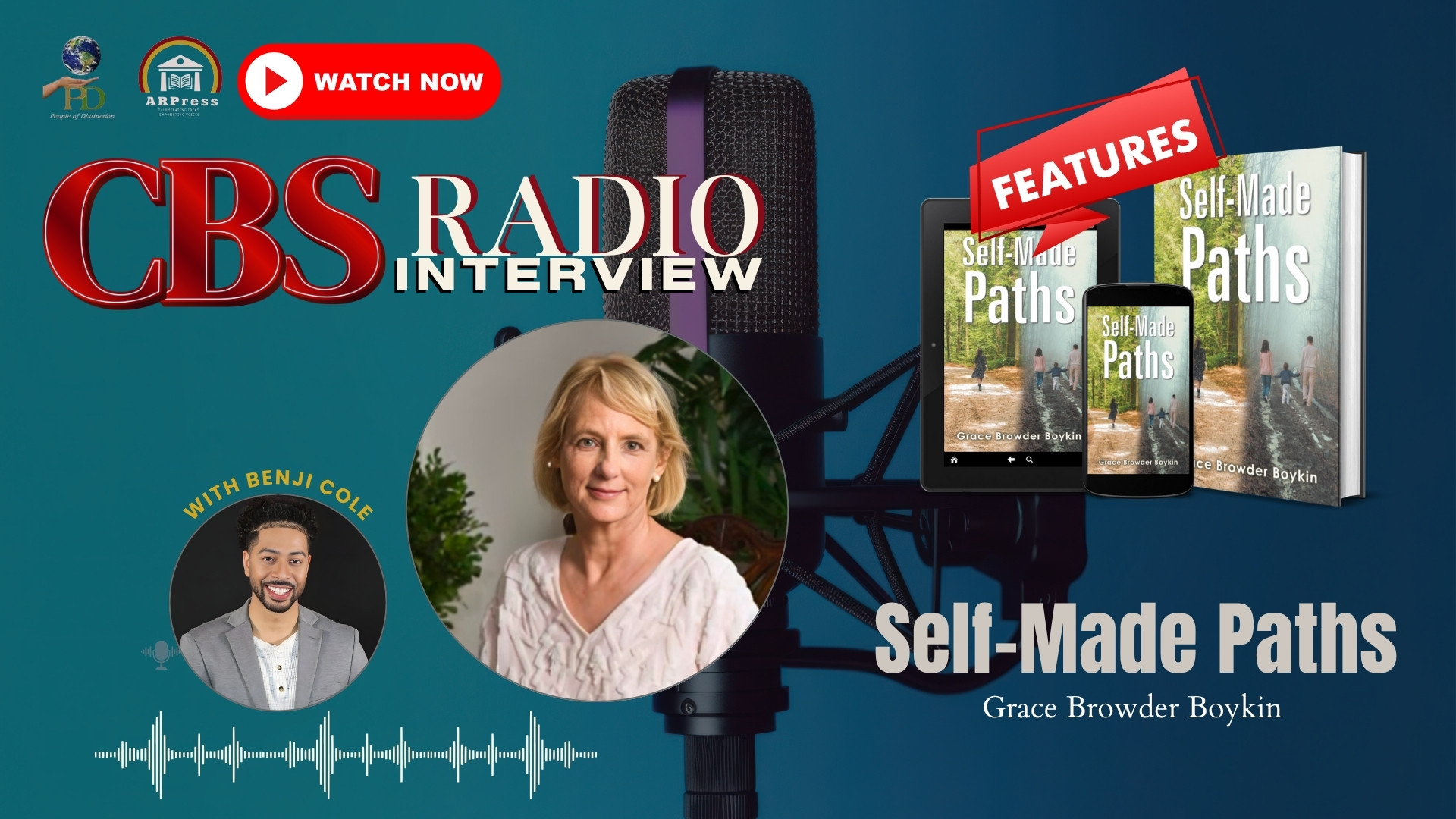
Author Grace Browder Boykin recently joined host Benji Cole on People of Distinction for an interview that goes far beyond a conventional book promotion. Instead, she offered a thoughtful, reflective conversation about identity, resilience, and forging a path worth walking.
People of Distinction, hosted by Benji Cole (and founded by his father, Al Cole), is known for giving authors the space to go deeper; to move beyond a book blurb and speak from the soul. Grace Browder Boykin’s appearance did just that. Listeners were treated not to a rehearsed promo, but to a sincere, thoughtful dialogue about personal identity, the power of untold stories, and the drive to define one’s own route forward.
What emerges in the interview is an author who isn’t simply telling history; she’s inviting us into the process of discovering it: the hidden stories, the overlooked details, and the way individual choices carve out broader narratives.
As Boykin discussed her motivation behind Self-Made Paths, she traced how her journey wasn’t a straight ladder but a series of pivots. Her upbringing, formal education, travel, and community-engagement all functioned like threads that came together to inform her writing. She doesn’t present herself as someone who followed a prescribed map; she spotted the gaps in conventional storytelling and stepped into them.
One memorable reflection: what does it mean to “make your own way”? For Boykin, it’s less about defying a roadmap and more about noticing the spaces where the map doesn’t go, the untold stories, the unnoticed influences, then choosing to walk through them.
A major theme of the discussion was the difference between what gets recorded in history and what gets remembered. In Self-Made Paths, Boykin focuses on lesser-known figures and the subtle influences behind prominent ones. She views history not as static but as living, breathing; made up of everyday persons whose choices ripple outward.
In the interview, she emphasized that her aim isn’t simply cataloging facts, but connecting them: showing how an individual’s agency, often in small or quiet ways, contributes to the larger story. She asked: what happens when we look closely at the “idiosyncrasies and hidden details” behind the well-known arcs? That, she argued, is where relevance lies.
Boykin didn’t shield the challenges. She acknowledged the tension between finding one’s voice and feeling invisible. She spoke about doubt, about entering spaces where the world seemed indifferent, even unwelcoming; yet she insisted that these are precisely the terrains where purpose often emerges.
One vivid point from the interview: when the world doesn’t seem to see you, that’s sometimes when you discover the value of what you see: the gaps, the stories you can bring. Her voice in the interview, warm, clear, grounded, reflected this honesty. She wove in anecdotes from teaching, traveling, uncovering overlooked narratives, all underscoring the idea that writing and story-work are grounded in lived experience.
What distinguishes Boykin’s approach is that writing becomes more than a craft: it becomes a service, to those whose stories might slip through the cracks, and a path of self-discovery. She described how her background in education, travel, and community leadership shaped her perspective: engaging with people and places, witnessing small acts of courage, exploring hidden corners of history.
She invited listeners (and by extension, readers) to consider this: What stories am I overlooking? What paths am I avoiding because I assume someone else will walk them? And if I did walk them, what ripple might I create?
Whether you’re a history buff, a writer, a creator, or simply someone trying to make sense of your own journey, Boykin’s interview offers something fresh: a renewed sense of wonder about how individual initiative intersects with the broader story of our culture. It’s a reminder that even when the roadmap is missing or incomplete, there are still meaningful paths to walk, ones that can matter.
Her book Self-Made Paths may appear on the surface to be about historical figures and presidents, but at its heart it’s about you and me; about how we carve ourselves into the narrative, how we make meaning of the overlooked, and how we step into the gap.
Get to know more about the author and the work as you listen to the full interview below: