
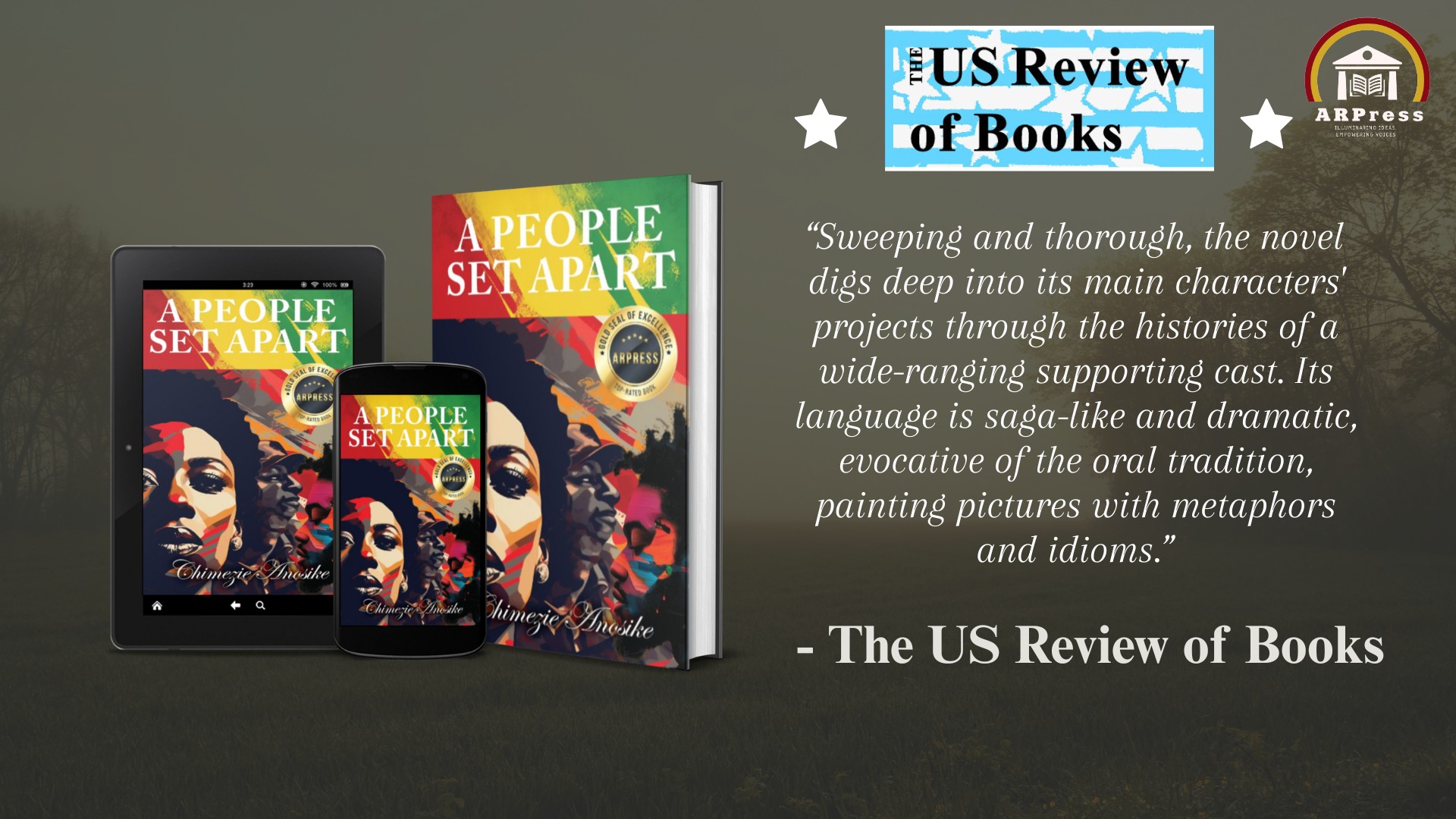
A People Set Apart by Chimezie Anosike has received acclaim from Mari Carlson of the US Review of Books. This is a song of endurance, a story that hums with the ache of loss and the stubborn pulse of hope. It speaks of a land torn and rethreaded, of people who refuse to forget their name even when history tries to erase it. Through war, friendship, exile, and return, the novel reminds that freedom isn’t just a flag or a border, it’s a state of being, shaped in the quiet choices of those who dare to rebuild. Chimezie Anosike doesn’t just tell the story of Biafra; he resurrects its soul, giving voice to a people who, though scarred by struggle, remains beautifully unbroken.
The US Review of Books doesn’t hand out praise lightly. So, when it called A People Set Apart by Chimezie Anosike “sweeping and thorough,” it meant something. This isn’t your average historical novel. It’s a bold, deeply layered story that reaches back into one of Africa’s most turbulent chapters, the Biafran War, and finds something both heartbreaking and inspiring buried in the rubble.
Set around the Nigerian Civil War (1967–1970), A People Set Apart follows young Chance, who’s sent to America for safety but later returns home to rebuild his world (literally). Alongside his American friend Turnkey, Chance dreams of creating a Biafran town that stands as a testament to freedom, dignity, and resilience. Their friendship, initially uneasy, becomes a mirror for the larger story Anosike is telling: one of understanding, rebuilding, and confronting prejudice that runs deeper than either character first realizes.
But this isn’t just Chance and Turnkey’s story. The US Review of Books points out that Anosike doesn’t skimp on his supporting cast or the tangled web of subplots. There’s Bucknor, another young Biafran who takes a very different path through the remnants of war; one marked by ambition and moral struggle. Through them, the novel paints a vivid picture of what it means to dream, to fail, and to start again in the shadow of conflict.
What really stands out, at least according to the review, is Anosike’s language. It’s not the stripped-down, modern kind you see everywhere today. It’s saga-like, rich, and dramatic, echoing the rhythm and spirit of oral storytelling. The kind of writing that doesn’t just tell a story but performs it. Characters speak in long, impassioned bursts, the kind of conversations that feel lived-in and real, as if they’ve been echoing for generations.
And there’s something timeless about that. The book doesn’t shy away from politics, corruption, or human frailty, but it never loses its heart. Even its villains, those tangled in greed and systemic rot, get their say. The US Review of Books admired how Anosike gives everyone a voice, showing how ideas, not just guns, can change the world.
By the end, what Chance, Turnkey, and Bucknor build, sometimes together, sometimes apart, feels like more than just a place. It’s a symbol of the novel itself: a creation forged out of both chaos and vision, grounded in the hard work of believing that something better can still rise from the ruins.
A People Set Apart isn’t just a war story. It’s a human story. One about friendship, justice, and the messy, hopeful process of rebuilding. And as The US Review of Books so aptly put it, it’s a “convincing extended fable,” one that stays with you long after the final page.
The US Review of Books (USRB) recommends A People Set Apart by Chimezie Anosike. Here’s the review from the USRB that highlights:
“Focused on building suspense as storylines weave together, the book also expresses the spirit of the age in historic figures and events. The villain characters are not short-changed. Their stories show, in greedy deals, the systemic corruption the heroes are up against. The vehicle for change is an exchange of ideas. In the end, the place Chance, Turnkey, and Bucknor design (sometimes together, mostly separately) is not unlike the novel itself—a physical manifestation of ideals wrought by a combination of happenstance and hard work.”