
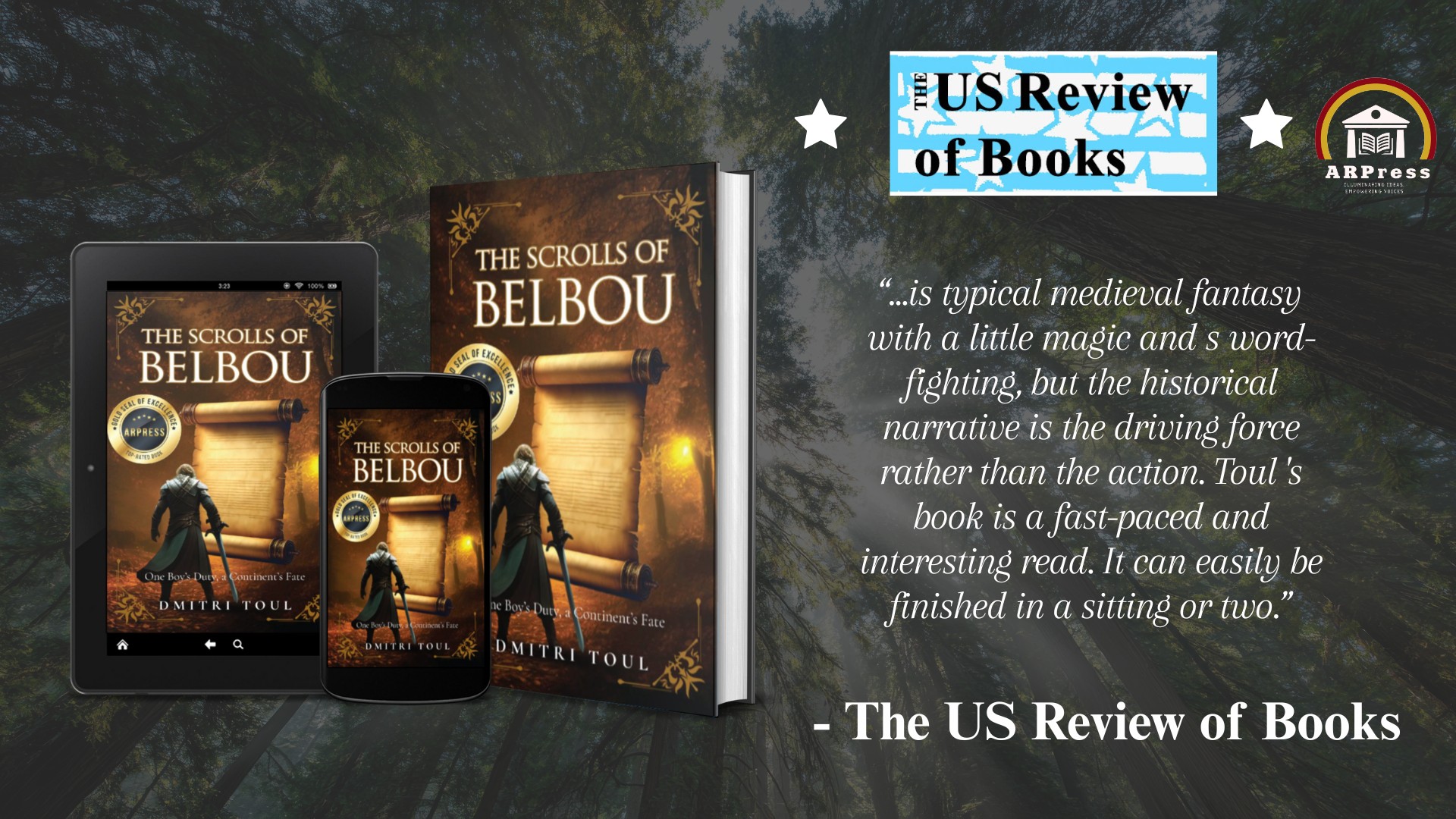
The Scrolls of Belbou by Dmitri Toul has received acclaim from Mark Heisey of the US Review of Books. Beneath the rustle of forgotten leaves and the hush of an untouched island lies the whisper of memory; a story about what endures when empires fall silent. The Scrolls of Belbou is more than a tale of adventure; it’s a meditation on legacy, on the fragile threads that bind the present to the ancient past. Through buried ruins and rediscovered scrolls, Dmitri Toul reminds readers that history never truly disappears, it only waits for those brave enough to listen.
Every so often, a book comes along that feels like it’s quietly waiting to be discovered, a story that doesn’t shout for attention, but earns it through depth, curiosity, and good old-fashioned adventure. Dmitri Toul’s The Scrolls of Belbou is exactly that kind of book. And apparently, it’s not just readers who think so, The US Review of Books (USRB) recently praised it for its engaging storytelling and thoughtful approach to fantasy.
The USRB review highlights what makes Toul’s work stand out: a layered narrative told in a “story-within-a-story” style that blends history, myth, and family dynamics. It’s the kind of structure that pulls readers in slowly: first with familiar, relatable characters, then with an ancient mystery that unfolds like a long-lost legend.
The setup feels almost cinematic. Bob, an anthropologist, changes his summer plans after his colleague, Mr. Moriarity, convinces him to investigate a remote island called Mylako. He brings along his wife, Nance, and their two kids, Roger and Sally, and before they know it, they’re knee-deep in rumors about an ancient kingdom and a mysterious structure hidden in the island’s forests.
Inside that structure? Eight scrolls, relics of a forgotten civilization and the key to a story that stretches far beyond their expedition. The second half of the novel dives into the tale of King Bathen and his people, as they defend their land against the dark conqueror Malechar. It’s got all the elements of classic medieval fantasy; sword fights, a touch of magic, and a sense of high-stakes destiny, but what really drives it is the historical depth Toul builds into the world.
The USRB called the book fast-paced and interesting, the kind of read that can be finished in one or two sittings. But what makes it linger isn’t just the action, it’s the mystery of lost history, and that haunting question Toul poses: how does a culture vanish from memory?
There’s a sense of care in the storytelling. Toul doesn’t just want to entertain; he wants to explore the thin line between myth and memory, and how stories can be both our greatest discoveries and our most fragile treasures.
It’s no surprise that the US Review of Books recommended The Scrolls of Belbou so highly. It’s smart fantasy; not the loud, sprawling kind, but the kind that sneaks up on you with quiet wonder and thoughtful worldbuilding.
For readers who love the mix of archaeology, ancient secrets, and fantasy that actually respects its own lore, Toul’s debut is a solid pick. And honestly? It feels like the start of something bigger, maybe even a series worth watching.
The US Review of Books (USRB) recommends The Scrolls of Belbou by Dmitri Toul. Here’s the review from the USRB that highlights:
“Toul ‘s novel is written in a story-within-a-story format. The first third is dedicated to getting to know the family and the guide as they journey to the ruins. The rest of the book is concerned with the story of King Bathen as he and h i s people defend their lands against the evil Malechar. This portion is typical medieval fantasy with a little magic and sword-fighting, but the historical narrative is the driving force rather than the action. Toul ‘s book is a fast-paced and interesting read. It can easily be finished in a sitting or two. Readers of fantasy who care about story more than a c t i on and enjoy a little mystery may find this a good start t o a new series.”